If you had to guess which town on Lake Minnetonka posted the strongest home value growth over the past year, Wayzata would be the obvious answer. It has the walkable downtown, the name recognition, the restaurant scene that keeps expanding. So why did six other towns on the same lake outgrow it?
Zillow's home value data, tracked through July 2026 and reported by Patch, ranks the fastest-appreciating communities across the Twin Cities metro. The top six spots all belong to towns that share Lake Minnetonka's shoreline: Minnetonka Beach, Greenwood, Tonka Bay, Woodland, Spring Park, and Orono. Wayzata comes in eighth, trailing every one of its lake neighbors that made the list.
Here is how the twelve months break down:
| Town | Value a year ago | Value now | Change |
|---|---|---|---|
| Minnetonka Beach | $2,054,143 | $2,351,689 | +14.5% |
| Greenwood | $1,561,320 | $1,705,598 | +9.2% |
| Tonka Bay | $1,042,183 | $1,131,361 | +8.6% |
| Woodland | $1,592,210 | $1,697,037 | +6.6% |
| Spring Park | $559,062 | $594,377 | +6.3% |
| Orono | $1,090,683 | $1,159,285 | +6.3% |
| Wayzata | $891,668 | $940,771 | +5.5% |
If you are comparing lake towns from a portal search, this looks like a red flag. It isn't. It is a clue about how each of these markets actually works, and it changes what you should be looking for depending on which price tier you're shopping.
What a Two-Sale Month Can Do to a Median
Small towns produce small sample sizes, and small sample sizes produce numbers that swing hard. One local market breakdown tracking Wayzata sales found that a single January 2026 stretch, with only two closed transactions, pushed the citywide median to $2.885 million. Two sales. One month. A number that would have looked like a headline-worthy surge if you didn't know how thin the underlying data was.
Minnetonka Beach, Greenwood, and Tonka Bay are smaller markets than Wayzata by transaction count. When a handful of expensive lakefront estates close in the same window, the percentage change looks dramatic even if the underlying demand hasn't shifted much. Wayzata has more sales volume moving through it, which smooths the curve. A 5.5% gain built on a deeper pool of transactions is a different kind of data point than a 14.5% gain built on a handful of them, even though the headline number makes the smaller town look like the hotter market.
This is the first thing worth unlearning if you're cross-shopping these towns: the town with the biggest percentage gain isn't necessarily the town with the strongest fundamentals. Sometimes it's just the town where fewer sales happened to move the average.
A Market That Priced In Its Premium Years Ago
There's a second, simpler explanation sitting underneath the data. Wayzata's downtown walkability, its school district, and its reputation as the social center of the lake are not new discoveries. Buyers have been paying for that combination for a long time, which means the premium is already baked into the price. A market that's already fully valued doesn't have as much room to move as a market that's still catching up.
The towns outgrowing Wayzata this year, Minnetonka Beach and Greenwood especially, tend to have smaller inventories of true waterfront lots and less of the amenity base that Wayzata offers. When buyers who want lake access get priced out of Wayzata's walkable core, some of them shift toward these quieter enclaves and bid up whatever shoreline is available there instead. That pressure shows up as a sharper percentage gain in a market that started from a lower base.
None of this means Wayzata is cooling. It means Wayzata's price already reflects what people are willing to pay for the combination of lake and downtown, while its neighbors are still working out what their own shoreline is worth in a market where waterfront lots simply cannot be replaced.
Three Very Different Things Called "Lakefront"
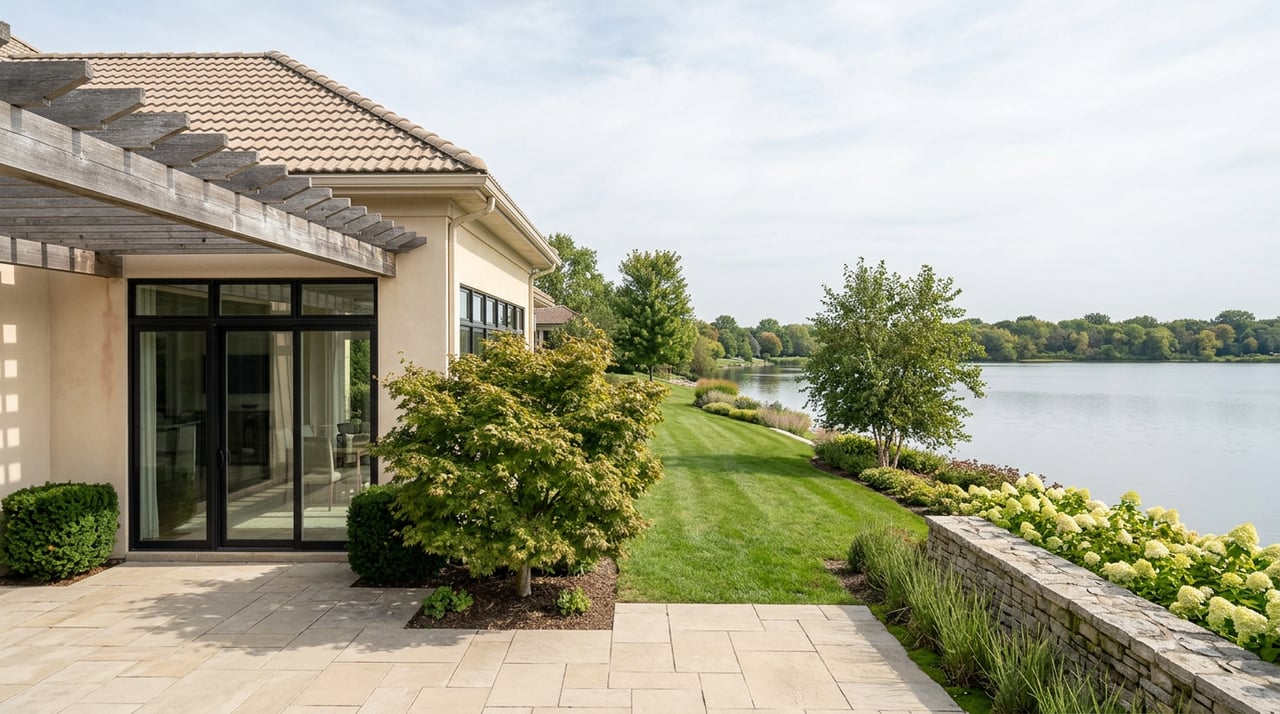
The other thing the median obscures is that "lakefront" does not mean one thing in this market. Depending on how a property sits relative to the water, you're buying into one of three very different tiers, and the gap between them explains why two homes with similar square footage can be priced a million dollars apart under the same city name.
- True lakefront. Your property line meets the water. You hold riparian rights and can apply for a dock through the Lake Minnetonka Conservation District, though approval still depends on lot width and the district's own rules. This is the tier where you'll see prices climbing well past $2 million and, on the most coveted bays, past $10 million.
- Deeded or shared-dock access. You don't own frontage, but an association or subdivision does, which gives you slip rights without paying for full lakefront footage. It's a meaningful discount off true lakefront pricing while still delivering boat access.
- Lakeshore-adjacent. A view, or a short walk to the water, with no ownership of shoreline and no dock rights attached. Priced well below the other two tiers.
Local listings this year illustrate the spread: homes across Wayzata's neighborhoods run from the $600,000s to well over $4 million, with lakefront estates in coveted spots like the Locust Hills enclave on Gray's Bay pushing past $10 million once true frontage and a private dock are part of the package. If you're comparing a listing description that says "lake views" against one that says "private dock," you are not comparing two versions of the same product. You're comparing two different asset classes that happen to share a zip code.
The Restaurant Scene Says Otherwise
If slower appreciation signaled weakening demand, you'd expect downtown Wayzata's business scene to be pulling back. It's doing the opposite. Parcelle, the organic cafe known for its northeast Minneapolis flagship, confirmed plans earlier this year to open its first suburban location right on the Wayzata lakefront, a small grab-and-go spot built for a lakeside walk or a patio sit in warmer months. At The Hotel Landing, the restaurant formerly known as ninetwentyfive relaunched in April 2026 as Belle & Grey with a refreshed dining room and a new seasonal menu. This summer, the city council approved an expanded outdoor patio at Eloise along Broadway Avenue, adding sidewalk seating for the rest of the 2026 season.
That's three separate signals in the same twelve months: a new concept moving in, an established spot reinventing its dining room, and a city council willing to expand outdoor seating downtown. None of that reads like a market losing its pull. It reads like a town whose day-to-day appeal keeps deepening even while its home value growth, measured purely as a percentage, sits behind its smaller neighbors.
What This Means If You're Comparing Towns This Fall
If you're shopping the $800,000 to $1.5 million range, Wayzata is still where you'll find the deepest inventory of homes that combine school district access with proximity to downtown, even if the shoreline itself is out of reach at that price point. If your priority is true waterfront and you have flexibility on which specific town it's in, Orono, Woodland, and Greenwood are worth cross-shopping precisely because their markets are still finding their footing, which can mean more negotiating room on a given listing even as the town-wide average climbs.
Either way, the number that matters most isn't the town's year-over-year percentage. It's which of the three lakefront tiers a specific listing actually falls into, and whether the price reflects that tier accurately. That's a conversation worth having before you write an offer, not after.
FAQ
Does slower appreciation mean Wayzata is a worse investment than its neighbors? Not necessarily. A market with more transaction volume tends to produce smoother, more reliable trend lines. A smaller town's higher percentage gain can reflect a handful of expensive sales rather than a broad shift in demand.
How do I confirm whether a listing has true lakefront rights before I make an offer? Ask for documentation on shoreline ownership and any existing dock permit status. The Lake Minnetonka Conservation District regulates dock eligibility separately from the deed itself, so frontage alone doesn't guarantee approval.
Is the $800,000 to $1.5 million range actually still available in Wayzata? Yes, primarily in inland neighborhoods within the school district rather than on the water itself. That band tends to move quickly given how limited inventory is at any given time.
If you're weighing Wayzata against its lake neighbors, or trying to figure out which lakefront tier actually fits your budget, Carrie Sink can walk through the specific listings and access rights behind these numbers. Request a Free Home Valuation to start the conversation.