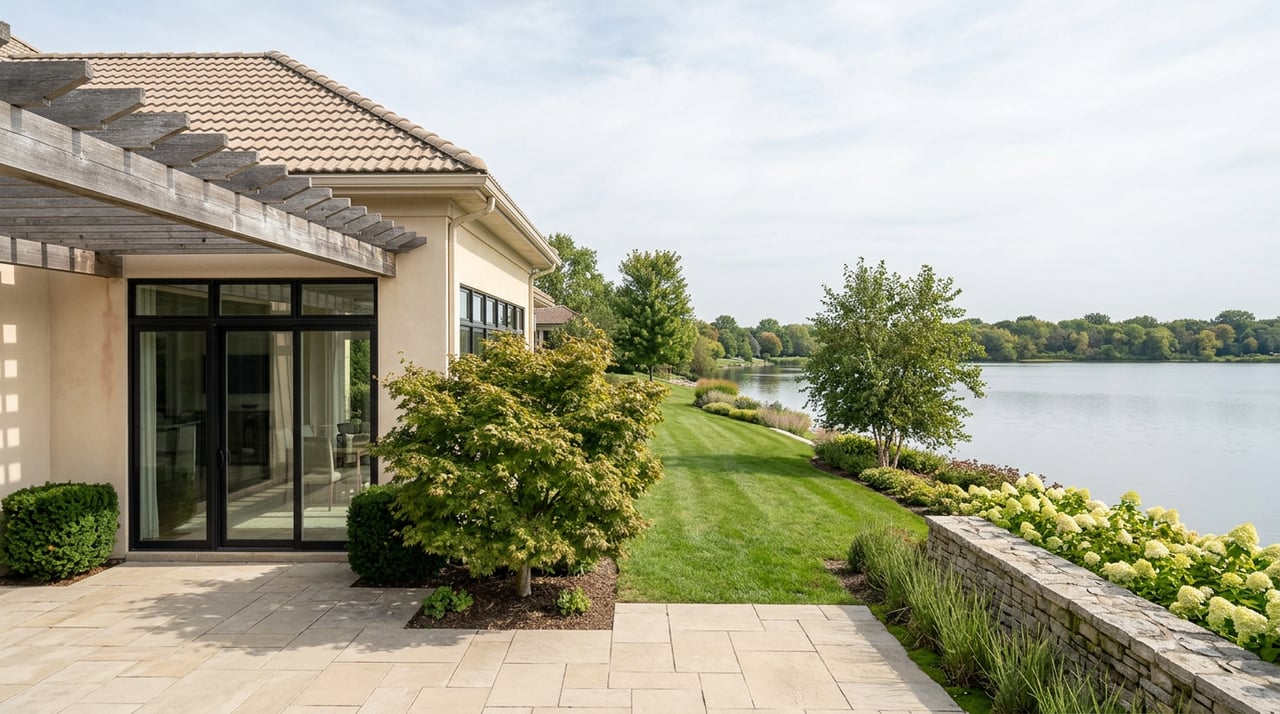
When Shawn and Annelie Bergerson listed their Maxwell Bay home for $6.25 million in 2025, the feature that sold them on the property years earlier wasn't the eleven-thousand-square-foot floor plan or the walls of glass. It was the quiet. Their stretch of Lake Minnetonka sits in a no-wake zone that the Lake Minnetonka Conservation District and Hennepin County put in place specifically to keep boats at 5 mph and keep wake boats out. "Privacy and quietness have always been really important to us," Bergerson told the Star Tribune when the home hit the market.
That quiet wasn't a feature of the house. It was a regulatory designation layered on top of the property, one the Bergersons didn't create and couldn't have removed if they wanted to. It's a useful way to understand how lakefront ownership actually works in Orono. The house is yours. A surprising amount of what makes it valuable is not.
If you're buying or selling shoreline here, the number that matters most isn't the price per foot of frontage. It's the paperwork that sits outside the purchase agreement entirely, deciding how many boats you can dock, where you're allowed to rebuild, and whether the thing you think you're buying was ever actually granted to anyone.
The Dock You Assume Is Yours May Not Be
Here's the assumption almost every lakefront buyer walks in with: if the lot touches the water, a dock comes with it. That's not how it works on Lake Minnetonka.
Owning frontage gives you the right to apply for a dock. It doesn't guarantee you'll get one, and it doesn't tell you what kind. Dock rights on this lake can be recorded, licensed, nonconforming, or simply absent, and the difference between those categories can be worth real money at resale. A licensed dock with documented Authorized Dock Use Area paperwork is a known quantity to a buyer's lender and title company. A nonconforming dock that's never been formally reviewed is a question mark that tends to surface during due diligence, usually at the worst possible time in a transaction.
The Lake Minnetonka Conservation District is the body that governs this, and it coordinates across every city that touches the lake, including Orono, Wayzata, Mound, and Minnetrista. That's not a formality. It means the rules that apply to your specific parcel depend on where your parcel sits, not just on the fact that it's lakefront.
Your Frontage Is a Quota, Not a Guarantee
Even once dock rights are confirmed, the LMCD caps how much boat you're allowed to keep there. The standard is one restricted watercraft per 50 feet of continuous shoreline. A property with 100 feet of frontage is generally looking at two boats. A property with 40 feet is looking at a negotiation, not a guarantee.
This is where the math gets interesting for anyone comparing two listings that both say "lakefront" in the description. A narrow lot with a premium view can still be capped at a single boat slip, while a wider lot two doors down with a less dramatic view supports a boathouse, a lift, and a pontoon without any variance at all. The frontage number in the listing isn't just a size. It's a ceiling on how the next owner gets to use the water, and buyers who skip this step sometimes find out only after they've made an offer that their boating plans don't fit their footage.
There's a second wrinkle worth knowing if a dock is being brought in from another lake or water body: it has to sit dry for 21 days first, a rule built to slow the spread of invasive species. It's a small detail, but it's exactly the kind of thing that catches a buyer off guard when a dock included in the sale turns out to have come from somewhere else.
Your Neighbors Draw Your Setback Line
If you're buying land in Orono with plans to build or substantially rebuild, there's a detail in the city's code that surprises almost everyone the first time they hear it. Orono determines how far your home can extend toward the water using what's called an average lakeshore setback, codified in the city's Ordinance No. 313. In practice, the city draws your buildable line by connecting the most lakeward points of the homes on the lots next to yours.
That means your setback isn't a fixed number you can look up once and rely on. It moves with your neighbors. If the house next door gets rebuilt closer to the water, your own envelope can shift with it, sometimes opening up more room, sometimes pulling it back. On a tight or irregular lot, this single provision can be the difference between a rebuild that pencils out and one that doesn't. Anyone shopping for a teardown or a major renovation on this shoreline should have this checked before falling in love with a lot, not after writing an offer on one.
Who Actually Regulates What
Part of why lakefront transactions on Lake Minnetonka take longer than buyers expect is that no single agency owns the whole picture. Here's how the layers break down:
| Agency | What It Controls |
|---|---|
| Lake Minnetonka Conservation District (LMCD) | Dock length, watercraft density, mooring rules, no-wake zones |
| City of Orono | Local zoning, shoreland overlay, setback ordinances like No. 313 |
| Minnehaha Creek Watershed District | Shoreline stabilization, dredging, drainage, erosion control |
| Minnesota DNR | Public Waters Work Permits for in-water or shoreline alterations |
| Hennepin County | Property records, easements, water patrol, septic oversight in many cases |
A project as simple as replacing a retaining wall can touch three of these five agencies. That's not a reason to avoid lakefront property. It's a reason to have someone on your side who already knows which office to call first.
The Septic Question Nobody Has to Answer
Here's the gap in the process that surprises the most buyers, and it's one worth sitting with. Hennepin County does not require a septic inspection at the time of sale. If a lakefront home in Orono isn't on municipal sewer, which describes a meaningful share of the older shoreline stock, there's no legal requirement forcing that system to be tested before it changes hands.
That doesn't mean the seller has nothing to disclose. It means the burden shifts to the buyer to ask for maintenance history, system age, and a current inspection as a condition of the purchase agreement rather than assuming it's baked into the process the way it might be for other utilities. On an older cottage that predates municipal sewer service and still relies on a private system, this is exactly the kind of detail that belongs in the negotiation, not in the surprise column after closing.
What This Means Before You Write or Accept an Offer
If you're selling shoreline property in Orono, the paperwork you can hand a buyer's agent upfront does more for your price than almost any staging decision. Keep your LMCD dock license and Authorized Dock Use Area documentation current and easy to produce. Have septic maintenance records and inspection history ready even though the county doesn't require them. If you've done any shoreline stabilization or drainage work, keep the permits that prove it was done through the Minnehaha Creek Watershed District rather than around it. Missing dock paperwork or undocumented shoreline work is one of the more common negotiation hurdles on this lake, and it's almost entirely avoidable with a folder of records assembled before the home ever goes live.
If you're buying, the questions to ask before you get emotionally attached to a listing are specific: Is the dock right recorded, licensed, or nonconforming? What's the shoreline footage, and does it support the boat setup you actually want? If you're planning to rebuild, has anyone checked what the average lakeshore setback looks like given the neighboring structures right now? And if the home relies on a private system, what does its maintenance history actually show?
None of this is about slowing you down. It's about making sure the version of lake life you're picturing matches the paperwork attached to the property you're about to own.
FAQs
Do dock rights automatically transfer when I buy a lakefront home in Orono? Not automatically. Dock rights on Lake Minnetonka can be recorded, licensed, nonconforming, or absent entirely, so it's worth confirming the status in writing before you're under contract rather than assuming frontage guarantees a dock.
Does Hennepin County require a septic inspection before I can sell my lake home? No. Hennepin County does not require a septic inspection at the time of sale, which means the responsibility to request maintenance history and a current inspection generally falls to the buyer as part of due diligence.
How is my buildable setback determined if I want to rebuild on the water? Orono uses an average lakeshore setback under Ordinance No. 313, which draws your buildable line by connecting the most lakeward points of the principal structures on the lots next to yours, meaning it can shift as neighboring properties are rebuilt.
Lake Minnetonka rewards buyers and sellers who do their homework before the paperwork becomes a problem. If you're weighing a shoreline purchase or preparing to list in Orono, Carrie Sink can walk you through what your specific frontage, dock status, and setback actually allow before you write or accept an offer. Request a free home valuation to start the conversation with the facts already on the table.